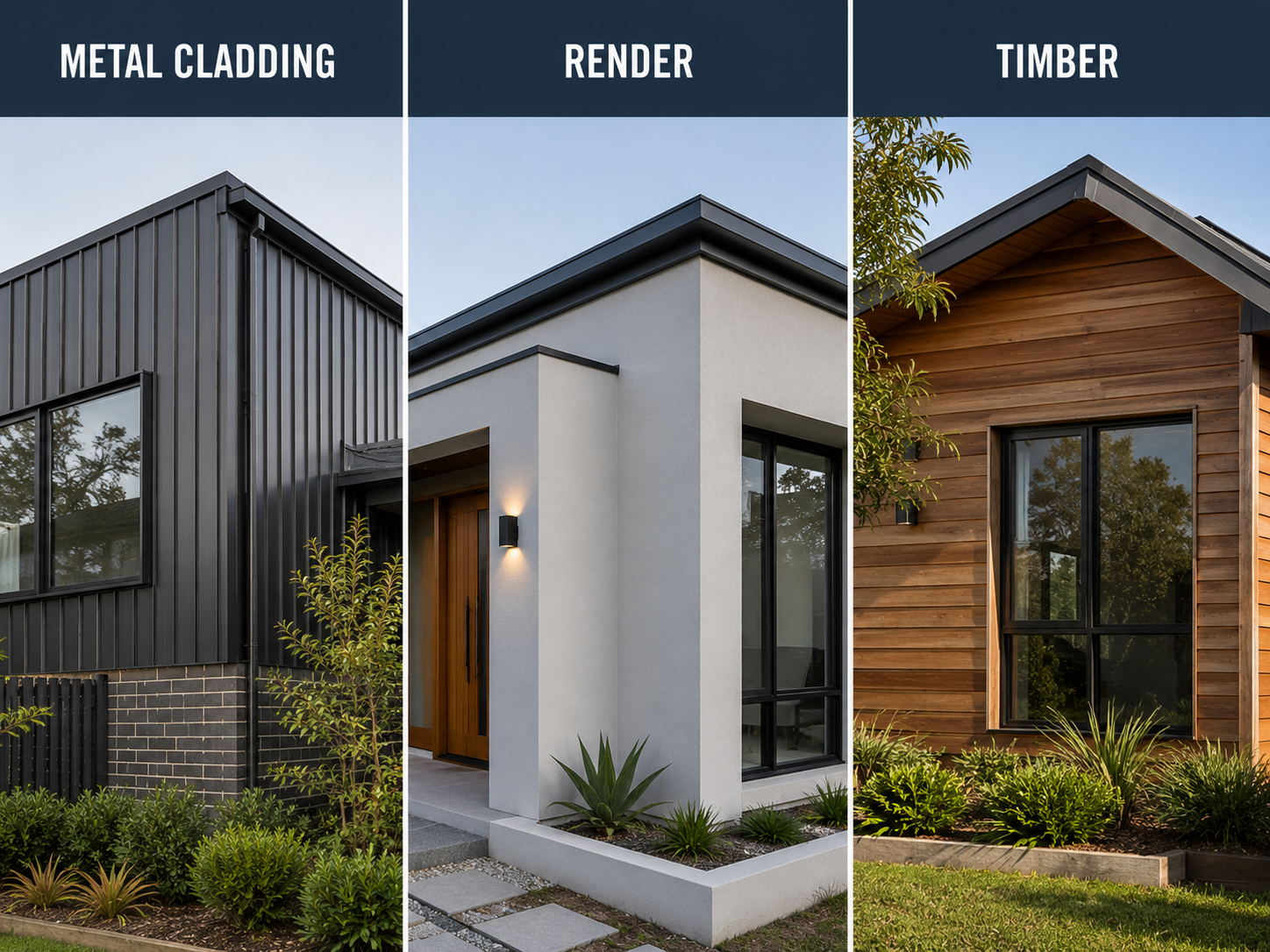
Architectural cladding covers the external walls of a home, affecting both appearance and performance. The three most common options for Melbourne homes are metal cladding, rendered masonry or hebel, and timber or timber-look cladding. Each has a different profile on cost, maintenance, lifespan and suitability depending on the home and location.
Here is a practical comparison.
Metal Cladding (Colorbond and Equivalent Products)
Metal cladding, most commonly Colorbond steel in various profiles, is increasingly popular on contemporary Melbourne homes and extensions. It is also the most common choice for commercial and industrial buildings.
Advantages
Durable and low maintenance. No painting required. Colorbond has a factory-applied finish with a long manufacturer warranty.
Lightweight compared to masonry finishes, which matters on older structures or upper-storey additions.
Fire-resistant. Important in higher BAL zones, though most inner Melbourne suburbs are not subject to BAL requirements.
Wide range of profiles and colours. Corrugated, flatline, shiplap and other profiles give significant design flexibility.
Handles Melbourne's weather well, including UV, rain and temperature cycling.
Disadvantages
Can look industrial or cold on period homes if not done thoughtfully.
More susceptible to visible dents than render or masonry.
Dissimilar metals in contact can cause corrosion if the job is not done correctly.
Render (Texture Coat, Acrylic Render, Hebel)
Rendered finishes have been the dominant external wall treatment on Melbourne homes built from the 1970s through to the 2010s. Acrylic texture coat over a block or brick base is common. Hebel (AAC panel) with a render finish has grown in popularity for new builds and extensions.
Advantages
Familiar, mainstream appearance that suits period-adjacent and traditional homes.
Good thermal mass if applied over masonry.
Seamless finish with no exposed joints.
Disadvantages
Cracks over time, particularly in areas with clay soils that shift seasonally, which is common across Melbourne's northern and eastern suburbs. Cracks let water in.
Once cracked or damp, repairs are visible unless the entire surface is repainted.
Requires repainting every 10 to 15 years to maintain appearance and weatherproofing.
Ongoing maintenance costs are higher than metal cladding over a 20-year period.
Timber and Timber-Look Cladding
Timber cladding, either natural hardwood or composite products designed to look like timber, is popular on contemporary homes and extensions where a warm, natural aesthetic is important.
Advantages
High-end appearance. Timber cladding reads as premium on both heritage and contemporary homes.
Composite timber-look products have improved significantly and offer better durability than natural timber with less maintenance.
Disadvantages
Natural timber requires regular oiling or painting to prevent cracking, warping and rot. In Melbourne's climate this means maintenance every 3 to 5 years.
Natural timber is not fire-resistant and is restricted or prohibited in BAL zones.
Higher upfront cost than render for natural hardwood.
Composite timber-look products are more durable but come at a significant cost premium over metal cladding.
Which Should You Choose?
The right answer depends on your home's architecture, your tolerance for ongoing maintenance, and your budget.
For a contemporary or modern home with minimal maintenance as a priority: metal cladding.
For a period home or one in a heritage overlay where render is more sympathetic: rendered finish.
For a high-end renovation where aesthetics are the priority and budget allows: natural or composite timber.